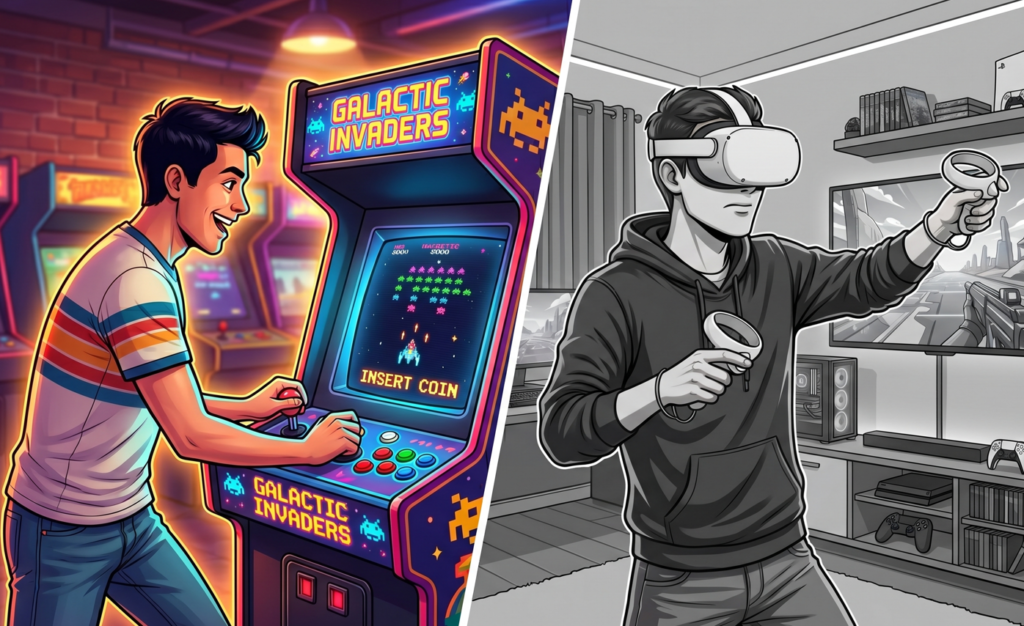
There’s a photo of me from the early nineties, standing on my tiptoes in a dimly lit arcade, hands gripping a joystick that was slightly too big for my small fingers. The screen glowed with pixelated aliens, and my face, captured mid-game, wore an expression of pure, unblinking focus. I don’t remember what I was playing. Probably something I lost at within seconds. But I remember how it felt. The sticky floor, the clatter of quarters on glass, the unspoken competition with the older kid waiting behind me.
Video games have come a long way since those noisy, neon-lit rooms. The journey from arcade cabinets to strapping a screen to your face and stepping inside a virtual world isn’t just a story of better graphics. It’s a story about how we’ve chased immersion, how technology has reshaped play, and how games went from a niche hobby to the dominant entertainment medium of our time.
The Arcade Era: Three Lives and a Pocket Full of Coins
In the late seventies and early eighties, video games lived in public. Arcades were their natural habitat, and games like Space Invaders, Pac-Man, and Donkey Kong became cultural phenomena. These machines were designed for one brutal purpose: to separate you from your quarters as efficiently as possible.
Game design in the arcade era was shaped by that economic reality. Difficulty ramped up quickly. There were no save points. Three lives and you were done. This created a culture of mastery and competition. High scores weren’t just personal achievements; they were bragging rights carved into a leaderboard for the whole neighborhood to see. You weren’t just playing the game. You were playing against everyone else who had ever stood at that cabinet.
Arcades were social spaces before games had online multiplayer. Friends gathered around a Street Fighter II machine, quarters lined up on the bezel to mark who had next. Winning meant you stayed on the machine. Losing meant you watched. The arcade was a theater of skill, luck, and the occasional rage quit.
The Home Console: Bringing the Arcade to Your Living Room
The arcade experience was glorious, but it was also expensive and inconvenient. You had to leave your house and keep feeding a machine money. The home console revolution, led by the Atari 2600 and later perfected by the Nintendo Entertainment System, changed the equation entirely.
Suddenly, the arcade came home. Super Mario Bros., The Legend of Zelda, and Metroid weren’t just arcade ports. They were deeper, longer experiences designed to be savored over weeks, not minutes. The focus shifted from high scores to narrative, exploration, and the satisfaction of finishing something.
This era also democratized gaming. Arcades could be intimidating places, especially for younger kids or anyone who didn’t feel like part of the scene. The living room was neutral ground. Parents played with children. Siblings fought over controllers. Gaming became a household activity rather than a public spectacle.
The console wars that followed, Sega versus Nintendo, PlayStation versus Xbox, pushed technology forward at a blistering pace. Each generation brought more powerful hardware, more complex games, and a wider audience. The disc replaced the cartridge. Memory cards saved your progress. Gaming grew up, and its audience grew with it.
The Online Revolution: The World in Your Headset
The next seismic shift came with the internet. PC gaming had dabbled in online multiplayer for years, but the mainstream console adoption of services like Xbox Live in the early 2000s changed the social fabric of gaming permanently.
Now you weren’t just playing against the person on the couch beside you. You were playing with, and against, people across the globe. Halo 2 matches trash-talked through crackling headsets. World of Warcraft guilds became communities as real and meaningful as any local club. The game was no longer just the software. It was the people inside it.
This era also gave birth to new genres that couldn’t exist offline. Massive battle royale games where a hundred strangers drop onto an island. Persistent online worlds that evolve even when you log off. Esports leagues that fill stadiums and pay teenagers millions. Gaming became a spectator sport, a social network, and a career path all at once.
Mobile Gaming: A Console in Every Pocket
Around the same time, a quieter revolution was happening in our pockets. The smartphone turned everyone into a gamer. You might not own a PlayStation, but you almost certainly had Angry Birds, Candy Crush, or Pokémon GO on your phone at some point.
Mobile gaming expanded the definition of who a gamer is. Commuters, grandparents, people who would never touch a traditional controller found themselves flicking birds at pigs or swiping candies on the train. The business model shifted, too. Free-to-play games funded by microtransactions and ads became the norm, for better and for worse.
The legacy of mobile gaming is complicated, riddled with predatory monetization and shallow time-wasters. But it also produced genuine gems and proved that the medium could reach audiences that the console and PC market never touched.
Virtual Reality: The Final Frontier of Immersion
For decades, virtual reality was a sci-fi fantasy. The clunky headsets of the nineties promised immersion and delivered motion sickness. The technology simply wasn’t ready. Then, in the 2010s, it quietly got there. Oculus, HTC Vive, and later PlayStation VR brought believable virtual worlds into people’s homes for the first time.
VR is fundamentally different from every gaming platform that came before it. A screen puts the game in front of you. A VR headset puts you inside the game. The difference is hard to describe until you’ve experienced it. Looking down and seeing a virtual body that isn’t yours but somehow feels present. Ducking behind cover because your brain, against all logic, believes the bullets are real. Your hands, tracked by controllers, reaching out to pick up objects in a world that doesn’t exist.
Half-Life: Alyx, Beat Saber, and Resident Evil 4 VR have shown glimpses of what the medium can do. It’s still early. The headsets are expensive, the cables frustrating, and the library of truly great experiences remains small. But the potential is staggering. VR isn’t just an evolution of gaming. It’s a new art form, a fusion of game design, theater, and embodied experience that we’re still learning how to use.
Augmented reality, blending digital objects with the real world, is developing alongside VR. Pokémon GO gave us a taste. Apple’s Vision Pro and similar devices suggest a future where digital and physical reality blur together, and games exist in the space around us rather than on a screen we face.
What Didn’t Change
For all the technological leaps, some things remain stubbornly the same. The arcade’s leaderboard lives on in every ranked ladder and battle pass. The split-screen couch co-op of the nineties survives in games like It Takes Two and the enduring appeal of local multiplayer. The joy of discovery, the frustration of a difficult boss, the friendships forged in virtual spaces, these are constants.
The hardware has evolved beyond recognition. The nature of play hasn’t. We still gather around screens, chase high scores, and lose ourselves in worlds that talented people built for us. The only difference now is we can step inside them, carry them in our pockets, and share them with someone on the other side of the world.
Gaming’s arc from arcade to VR isn’t a straight line. It’s a messy, sprawling web of experiments, failures, and breakthroughs. And the most exciting part is that we’re still somewhere near the beginning. The next frontier is always just around the corner, waiting for someone to drop in a quarter and press start.