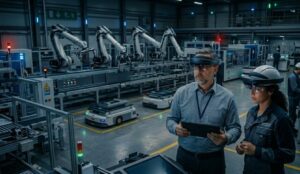
The conversation around artificial intelligence in manufacturing has shifted. For years, we heard breathless predictions about lights-out factories run entirely by machines. The reality unfolding on shop floors is far more interesting, and far more practical. We are not replacing human judgment wholesale—we are augmenting it, filling gaps that have dogged industrial processes since the first assembly line.
What follows is a look at where AI actually stands in industrial automation today and, more importantly, where it is heading over the next decade.
From Reactive Maintenance to Predictive Intelligence
For decades, maintenance followed a simple rhythm: fix it when it breaks, or replace it on a schedule someone guessed was conservative enough. Both approaches waste money, either through unplanned downtime or through swapping out parts that still had life in them.
The change now is in the granularity of prediction. Sensors on a motor no longer just report temperature spikes. Vibration analysis paired with machine learning models can detect a bearing degradation pattern specific to that exact unit, under that exact load, and estimate remaining useful life within a surprisingly narrow window. The operator gets a notification not to replace something, but to plan a service stop three weeks from now during a low-production period.
What makes this more than incremental progress is that these systems learn across fleets. A turbine in one plant teaches the models for identical turbines in a dozen others. The future is not just predictive maintenance; it’s federated learning across entire asset networks, where the fleet gets smarter with every operating hour, without requiring sensitive data to leave the plant.
Quality Control Moves Upstream
Quality inspection has traditionally been a gate at the end of the line. A human—or, more recently, a fixed vision system—checks the finished product and passes or rejects it. AI is slowly making that model obsolete, not by catching defects earlier, but by preventing them from ever happening.
Vision systems now sit mid-process, analyzing welds, surface finishes, or assembly tolerances in real time. The deeper shift, though, is the connection between what the cameras see and what the process parameters are doing. If a slight temperature drift in an injection molding barrel consistently maps to a cosmetic defect five cycles later, the AI recommends a correction before the defect materializes. There’s no part to reject because the line self-corrected.
This is not speculative. Automotive suppliers and electronics manufacturers are running these closed-loop systems today. The future is extending this to high-mix, low-volume environments where frequent changeovers made traditional automation uneconomical. Generative AI that can interpret a new product specification and automatically adapt inspection criteria and process windows will make small-batch quality control dramatically cheaper.
Robotics That Adapt to Variability
Industrial robots have been brilliant at performing precisely the same motion a million times. Introduce any variance—a part arriving slightly rotated, a flexible component that droops, a bin of randomly oriented pieces—and traditional automation struggles badly.
The union of robotics and AI is cracking this open. Modern vision-guided robots don’t need parts presented in perfect orientation. They can identify an object in a cluttered bin, plan a collision-free pick path, and adjust grip force based on the material they’re handling. This capability, which required a PhD team and months of integration work five years ago, is becoming a standard feature in picking cells.
The next step is robots that learn tasks by watching humans, not by being explicitly programmed. Several research labs and startups have demonstrated robotic arms that can observe a person perform an assembly sequence a handful of times and then replicate it, generalizing across minor variations. For small manufacturers who could never justify the engineering cost of traditional robotic integration, this is the door that finally opens. The cobot that sits alongside a welder or assembler, learns their technique, and then takes over the repetitive portion of their work, is no longer a prototype.
The Control Room Gets a Copilot
Ask an experienced process engineer what they actually do during a shift, and a large part of the answer is pattern recognition. They watch trends on dozens of screens, catch anomalies that haven’t tripped an alarm yet, and make small adjustments that keep a complex chemical process or power plant in its sweet spot.
That expertise is scarce, and a generation of operators is heading toward retirement. The industrial AI copilot doesn’t replace them; it captures and extends their capability. Large language models trained on operating manuals, maintenance logs, and years of historian data can now answer plain-language queries in real time. An operator can type, “Why is column temperature rising when feed rate hasn’t changed?” and receive a ranked list of probable causes drawn from both physics and plant-specific history.
Process optimization is moving in the same direction. Reinforcement learning models, given a simulator of a plant or even a digital twin fed by live data, can discover operating strategies that maximize throughput or minimize energy consumption within safety constraints. A few petrochemical facilities already run these models in closed-loop advisory mode, where the AI suggests setpoint changes and the operator approves them. The leap to full closed-loop control, where the optimizer writes directly to the distributed control system, is a matter of trust and regulatory evolution, not technical capability.
The Convergence of IT and OT Finally Happens
For two decades, the separation between information technology and operational technology has been a source of friction, cost, and cybersecurity risk. AI is forcing the marriage.
Running an inference model on a factory floor is not like running it in a cloud data center. Latency matters. Determinism matters. A model that takes two hundred milliseconds to flag an anomaly on a high-speed packaging line is useless. This is driving a new generation of edge computing hardware purpose-built for industrial AI workloads, sitting physically close to the machines and connected directly to programmable logic controllers.
The standard that matters here is not from the consumer internet world. It is OPC UA and its extensions, which allow models to discover assets, subscribe to their data streams, and write back control commands in a vendor-agnostic way. The plants that do this well are building unified data fabrics where a vibration model, an energy forecasting model, and a production scheduling model all pull from the same real-time source, rather than hunting through a dozen proprietary historians.
Where This Leaves the Workforce
A fair question hangs over all this progress: what happens to the people? The evidence from early adopters is consistent. AI does not eliminate the operator, the maintenance technician, or the quality engineer. It eliminates the parts of their jobs that are repetitive, dangerous, or require processing more information than a human can hold in their head at once.
The maintenance technician who used to spend half the shift walking routes and writing down gauge readings now investigates the exceptions the AI surfaced. The quality engineer who sorted through defect images now designs experiments to fix the root causes the AI identified. The operator who watched a screen for alarms now manages a team of automated processes, intervening when the system reaches the edge of its confidence.
The gap, and it is a real one, is in skills. Companies that treat AI adoption as purely a technology project will struggle. Those that invest in data literacy, in teaching technicians to interpret probability distributions rather than just binary alarms, and in creating career paths that reward diagnostic judgment rather than rote execution, are the ones that will capture the full productivity upside.
Industrial AI has passed the peak of inflated expectations and is settling into the hard, valuable work of making physical systems more productive, more reliable, and more sustainable. The future is not a dark factory devoid of people. It is a factory where people are finally free from acting as human sensors and low-level controllers, and are instead doing what humans do best: solving novel problems, exercising judgment, and improving the system. That shift is already underway, and it is irreversible.