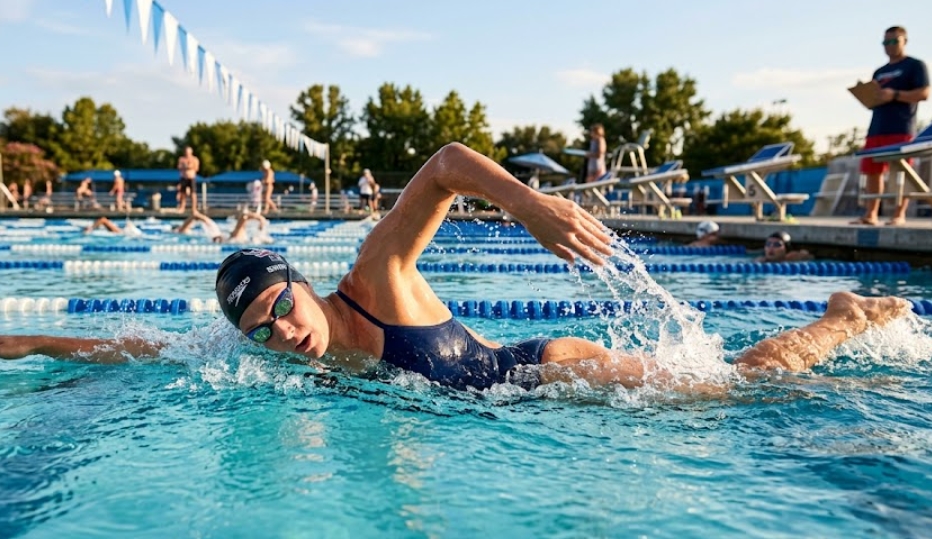
Swimming is one of those rare activities that looks effortless when done well and feels impossible when done poorly. Watch an Olympic swimmer glide across the pool, and you’d swear the water was parting out of respect. Then you jump in yourself, thrash around for a length, and arrive at the other end gasping like you just fought a river and lost.
The difference isn’t just fitness. It’s not even mainly fitness. A swimmer with beautiful technique will move through the water faster and with less energy than a much fitter swimmer fighting the water with every stroke. Swimming is a skill sport disguised as an endurance sport. And the good news is that technique improvements deliver faster results than just grinding laps.
Here are the fundamental techniques that actually move the needle, whether you’re a beginner trying to survive a lap or an experienced swimmer looking to drop time.
Body Position: The Foundation Everything Else Sits On
Before you worry about your arms, your kick, or your breathing, you have to fix where your body sits in the water. Most struggling swimmers drag their legs low, their hips sinking, their body angled upward like a snowplow pushing water instead of slicing through it. Water is roughly eight hundred times denser than air. Drag is your enemy, and a poor body position multiplies it.
The goal is to float as horizontally as possible, with your hips high and your legs near the surface. Your head position controls everything. Look straight down at the bottom of the pool, not forward. Lifting your head pushes your hips down. It’s a simple lever effect. Head up means legs down. Head neutral, eyes down, means legs rise.
Press your chest gently into the water. This sounds counterintuitive, but pressing your upper body down helps your hips rise, aligning your whole body closer to the surface. Think of your body as a seesaw. The lungs are buoyant, which naturally lifts your chest. You counterbalance by engaging your core and pressing slightly forward and down. The sensation is one of swimming downhill, even though the pool is flat.
A good drill to feel this is the push-off glide. Push off the wall face down, arms extended, and just glide. Don’t kick. Don’t move. Just feel where your body settles. If your legs drop, tuck your chin and press your chest slightly. Find the position where you glide the farthest. That’s your baseline.
The Catch: Grabbing Water That Isn’t There
The most common inefficiency in swimming is the arm that slips through the water without holding onto anything. You see it everywhere at public pools. Arms windmilling, splashing, working hard but generating more noise than propulsion. The water feels slippery because the swimmer isn’t catching it.
The catch is the moment your hand enters the water and grabs hold. But “grabbing water” is an abstract concept until you feel it. A better way to think about it is anchoring your hand and forearm in the water and pulling your body past that anchor, rather than pulling your arm back through the water. The distinction is subtle but transformative. You’re not moving your hand backward. You’re moving your body forward past a hand that’s holding a stationary piece of water.
Your forearm matters as much as your hand. A common mistake is pulling with a straight arm, which uses only the hand as a paddle. Bending the elbow early and keeping the forearm vertical during the pull creates a much larger surface area. The hand, forearm, and upper arm form a paddle that moves a lot more water. This is called the high elbow catch, and it’s probably the single technique change that yields the biggest speed improvement per unit of effort.
A drill that helps is sculling. Float face down with your arms extended, and make small figure-eight motions with your hands to feel the pressure of water against your palms and forearms. Move slowly. Pay attention to the sensation of holding water. When you can feel that pressure consistently, carry it into your full stroke.
Breathing: The Skill That Calms Everything Down
Breathing is where swimming technique and survival instinct collide. Your brain knows you’re surrounded by water. It would very much like you to lift your head, gasp for air, and generally panic. The problem is that lifting your head destroys your body position and throws your stroke out of rhythm.
The key to comfortable swimming is learning to breathe without disrupting your alignment. In freestyle, you rotate your head to the side, not up. One goggle stays in the water. Your mouth clears the surface because your body roll creates a pocket of air beside your head, not because you’re craning your neck upward.
Exhale fully underwater before you turn to inhale. This is the detail beginners miss constantly. If your lungs are still half full of old air, you can’t inhale fresh air quickly. You end up with a hurried, shallow breath and a mounting sense of panic. Blow out steadily through your nose while your face is down. By the time you turn to breathe, your lungs are empty and ready to fill. The inhale is a quick, relaxed sip, then your face is back in the water.
Bilateral breathing, breathing on both sides, alternates stress across your neck and shoulders and helps maintain a symmetrical stroke. It’s worth learning even if it feels unnatural at first. You don’t have to breathe every three strokes in a race, but having the ability to breathe comfortably to either side gives you options and balance.
The Kick: Smaller, Smarter, Less Exhausting
The kick is the most misunderstood element of swimming. Novices kick furiously, splashing white water behind them, burning through oxygen, and moving slower than if they barely kicked at all. A big, wide, frantic kick creates enormous drag while using the largest muscles in the body, which demand oxygen you need for everything else.
An efficient flutter kick is small, fast, and originates from the hips, not the knees. The legs are long and relatively straight, with a slight, relaxed bend in the knee. The movement is a whip-like flick, not a bicycle pedal. Think of kicking from your hip flexors and glutes, with your feet just finishing the movement.
The ankles should be relaxed, almost floppy. Stiff ankles act like brakes. Soft, flexible ankles allow the foot to act like a fin. Point your toes but don’t clench. Some of the best swimmers have remarkably flexible ankles that bend past flat, giving them a propulsion advantage with less effort.
For distance swimming, the kick contributes a relatively small percentage of your propulsion. Its main job is to keep your legs up and maintain rhythm. A steady, compact two-beat kick, one kick per arm stroke, is enough for most recreational and distance swimmers. You’re kicking to streamline, not to power through the water. Save the explosive six-beat kick for sprints.
Rotation: Swimming on Your Side
The human body moves through water more efficiently when it’s rotated to the side, not flat and wide. Rotating along the spine’s long axis reduces frontal surface area, cuts drag, and puts your shoulders in a stronger position to execute a powerful catch.
Think of your stroke as spearing forward from one side to the other. As your right arm extends forward, your body rotates slightly to the right, perhaps thirty to forty-five degrees, and your left shoulder clears the water. As you pull with the right arm and your left arm recovers forward, your body rotates to the left side. The rhythm is a gentle rocking, driven by the hips and core, not just the shoulders.
Rotation also makes breathing easier because your head turns naturally with your body rather than twisting independently. And it engages the large muscles of your back and core in every stroke, distributing the workload away from your shoulders, which are vulnerable to overuse injury if they do all the work.
A useful drill is side-kicking. Kick on your side with your lower arm extended forward and your upper arm resting on your hip. Practice breathing by turning your head slightly. Switch sides by taking a stroke. This drill teaches you to feel comfortable rotated, to breathe without lifting your head, and to connect your kick to your body’s alignment.
The Recovery: Where Tension Goes to Die
The recovery is the phase when your arm is out of the water, swinging forward to re-enter for the next stroke. Because it’s not generating propulsion, swimmers often ignore it. But a tense, rushed recovery bleeds energy and tightens muscles that need to stay loose.
Your elbow should exit the water first, leading the arm forward. The hand stays close to the water but doesn’t drag through it. The shoulder, elbow, wrist, and hand stay relaxed. Think of your arm as a rope being pulled forward by your elbow. The movement is controlled but soft. Tension in the recovery arm translates to tension in your neck and shoulders, and tension kills efficiency.
A classic drill is fingertip drag. Swim freestyle normally, but during the recovery, drag your fingertips lightly along the surface of the water. This forces a high elbow position, relaxes the arm, and prevents a wide, swinging recovery that throws off balance. Once you’ve felt the relaxed, high-elbow path, remove the fingertip drag and try to replicate the feeling.
Putting It All Together
Swimming improvement isn’t about fixing everything at once. That’s overwhelming and usually counterproductive. Pick one thing, focus on it until it starts to feel automatic, then move to the next. Body position first. Then breathing. Then the catch. The sequence matters because each technique builds on the one before it.
Drills are your friends, but only if you do them mindfully. Going through the motions while daydreaming won’t rewire your movement patterns. Pay attention to the sensation. What does good body position feel like? What does a solid catch feel like? The goal is to encode those sensations so your body can reproduce them without conscious thought.
Video feedback is invaluable. You cannot feel what you look like in the water. A friend filming you from the side with a phone, even for a single length, will reveal things that feel completely different from how they look. Your perception of your stroke and your actual stroke are often strangers to each other. Video introduces them.
The Bottom Line
Swimming is a lifelong conversation between your body and the water. Some days the water lets you move through it smoothly, and you feel like you’ve solved something fundamental about the universe. Other days it feels thick and stubborn, and every stroke is a fight. That’s normal. Even elite swimmers have days where the water doesn’t cooperate.
The difference is that with solid technique, the bad days are fewer and the good days feel like flying. You stop wrestling the water and start working with it. Your breathing settles. Your stroke lengthens. The laps click by with a rhythm that feels almost meditative.
All of that starts with the fundamentals. Body position, catch, breathing, kick, rotation, recovery. Master those, and swimming stops being something you survive and becomes something you actually look forward to. The pool will still be there tomorrow. Might as well move through it beautifully.