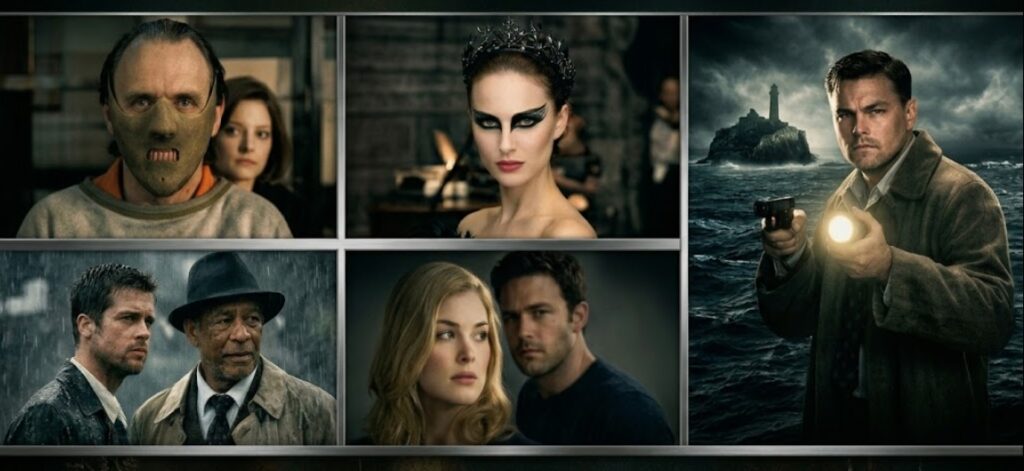
A good psychological thriller doesn’t need a monster, a ghost, or a jump scare. It needs something far more unsettling: a mind under pressure. The best of the genre burrow into your thoughts, blur the line between what’s real and what’s imagined, and leave you questioning not just the characters on screen but your own perception of what you just watched. These aren’t movies you simply enjoy. They’re movies you survive, and then spend the next three days thinking about.
The psychological thriller genre has produced some of cinema’s most enduring masterpieces. Here are five that represent the absolute peak of the form, films that will crawl inside your head and make themselves at home.
1. The Silence of the Lambs (1991)
Jonathan Demme’s masterpiece is the gold standard against which all psychological thrillers are measured, and for good reason. It’s the only horror-adjacent film to ever win the Academy Award for Best Picture, and it earned that trophy by being essentially perfect.
Clarice Starling, played by Jodie Foster with a trembling determination that makes you want to protect her and cheer for her simultaneously, is an FBI trainee sent to interview Dr. Hannibal Lecter, a brilliant psychiatrist and cannibalistic serial killer, in his basement cell. Anthony Hopkins is on screen for barely sixteen minutes, and he won the Oscar for Best Actor. That’s the level of performance we’re talking about. Every syllable he speaks is a weapon. Every pause is a trap. Lecter doesn’t just talk to Clarice. He dissects her, peeling back layers of her psyche with the precision of the surgeon he once was.
What makes The Silence of the Lambs transcend its genre is the relationship at its center. Clarice goes to Lecter for help catching another killer, Buffalo Bill, but what develops is something stranger and more complicated. He respects her. He protects her, in his way. And she learns to use him without being consumed by him. The film is a duet, two brilliant minds circling each other in the dark.
The famous night vision sequence, where Clarice stumbles through total darkness while Buffalo Bill watches her through a green-tinted scope, is one of the most terrifying set pieces ever filmed. But the scene that stays with you is the first meeting between Clarice and Lecter, a slow walk down a hallway of caged monsters, ending at a man who stands perfectly still in the center of his cell, waiting. “Closer, please. Closer.”
2. Black Swan (2010)
Darren Aronofsky’s Black Swan is a psychological thriller about ballet, but describing it that way feels almost dishonest. It’s a psychological thriller about perfectionism, repression, the violent collision between the person you are and the person you’re trying to become.
Natalie Portman won the Oscar for her performance as Nina Sayers, a technically flawless ballet dancer who wins the lead role in a production of Swan Lake. She is perfect for the White Swan, innocent, fragile, controlled. But she must also dance the Black Swan, seductive, reckless, free. The role demands she become both, and the effort of trying destroys her mind.
The genius of Black Swan is the way it traps you inside Nina’s subjective experience. We see what she sees. We hear what she hears. And as her grip on reality loosens, the film becomes a hallucinatory nightmare. Mirrors reflect things that shouldn’t be there. Paintings move. Her own body betrays her in increasingly grotesque ways. A rivalry with a fellow dancer, played by Mila Kunis with a dangerous warmth, may be real or may be a projection of everything Nina fears and desires.
The cinematography follows her with a handheld intimacy that makes you feel her anxiety in your own chest. The sound design amplifies every footstep, every breath, every crack of a joint. The climax, set during the actual performance of Swan Lake, is as visually and emotionally overwhelming as anything in modern cinema. When it ends, you feel like you’ve been holding your breath for two hours.
3. Se7en (1995)
David Fincher’s Se7en is a film about two detectives hunting a serial killer who murders according to the seven deadly sins. That premise could have been a straightforward police procedural. In Fincher’s hands, it became a descent into a world so bleak, so rain-soaked, so morally exhausted, that the killer’s apocalyptic worldview starts to feel almost inevitable.
The unnamed city where the story takes place is a character in itself. It never stops raining. The buildings are decaying. The lights flicker. People shout at each other from windows. It’s a world that seems to have been abandoned by God, which is exactly the killer’s point. John Doe, played by Kevin Spacey with a terrifying calm, believes he is doing holy work, exposing the sin that has rotted the world.
Morgan Freeman’s Somerset is a veteran detective weeks from retirement, a man who has seen too much and lost too much faith. Brad Pitt’s Mills is young, impulsive, and convinced he can make a difference. Their partnership is the heart of the film, and the way their different responses to evil shape the devastating final act is masterful screenwriting.
The ending of Se7en is famous for a reason. “What’s in the box?” has become a cultural reference point, but the scene itself is almost unbearably tense, a slow-motion tragedy that unfolds in a barren field under a flat gray sky. The film doesn’t offer catharsis. It offers a question: in a world this broken, is hope naive, or is it the only thing that keeps us human? Fincher doesn’t answer. He just lets the credits roll and leaves you sitting in the dark.
4. Gone Girl (2014)
David Fincher appears twice on this list because he is, quite simply, the master of the modern psychological thriller. Gone Girl, adapted by Gillian Flynn from her own novel, is a different beast from Se7en. It’s a thriller about marriage, about the stories we tell about ourselves, and about the terrifying gap between the person we present to the world and the person we actually are.
On the morning of his fifth wedding anniversary, Nick Dunne’s wife Amy disappears. There are signs of a struggle. Nick, played by Ben Affleck with a slippery charm that keeps you uncertain whether to trust him, becomes the prime suspect. The media circus descends. The public makes up its mind. Nick seems guilty, but the film keeps you guessing.
Then comes the midpoint twist, and everything you thought you understood about the story reverses. To say more would spoil one of the great narrative pivots in recent cinema, but Rosamund Pike’s performance as Amy Dunne is a revelation. She earned an Oscar nomination for a role that requires her to be about six different people at once, each version a mask over the one beneath. Her cool, calculating monologue, delivered in voiceover while the truth of the situation dawns on the audience, is chilling in its clarity.
Gone Girl is a thriller, but it’s also a satire of true-crime media, a dissection of gender roles, and one of the darkest comedies ever made about the institution of marriage. The final scene is a knife in the gut, a conclusion that resolves the plot while leaving the emotional horror simmering indefinitely.
5. Shutter Island (2010)
Martin Scorsese’s Shutter Island was initially received with a shrug from some critics who saw it as a minor work from a major director. Time has been kind to it. It’s now recognized as one of the most effective psychological thrillers of the century, a film that rewards rewatching in ways that are almost unfair the first time through.
Leonardo DiCaprio plays Teddy Daniels, a U.S. Marshal investigating the disappearance of a patient from a mental institution for the criminally insane, located on a remote island off the Massachusetts coast. A storm is coming. The staff is unhelpful. The patients are unsettling. Teddy’s partner, played by Mark Ruffalo, seems reliable but slightly off. Nothing on Shutter Island is quite what it appears to be.
Scorsese directs with a Gothic sensibility, filling the frame with howling wind, crashing waves, and the looming architecture of an institution that feels more like a prison than a hospital. The atmosphere is suffocating. The clues pile up, but they don’t add up, and the deeper Teddy digs, the more the mystery resists resolution.
The final revelation, when it arrives, recontextualizes everything. On first viewing, Shutter Island is a puzzle box. On second viewing, knowing the truth, it becomes a tragedy. Every scene plays differently. Every line of dialogue carries a double meaning. The final line of the film, delivered by DiCaprio with a devastating, quiet ambiguity, is one of the great closing moments in thriller history. It asks whether sanity is a gift or a burden, and it leaves the answer hauntingly open.
What Makes These Films Endure
These five films share some common threads. They all understand that the most terrifying thing is not what jumps out of the dark but what the human mind can do to itself. They all feature protagonists who are unreliable in some fundamental way, whether they’re being manipulated by a genius psychiatrist, losing their grip on reality, or actively deceiving the audience. They all reward rewatching, because the second viewing reveals details and meanings that were invisible the first time.
Most importantly, they all understand atmosphere as a storytelling tool. The Silence of the Lambs uses its basement corridors and caged inmates to build dread. Black Swan turns the backstage of a ballet company into a psychological war zone. Se7en drowns its world in rain and grime and hopelessness. Gone Girl weaponizes the glossy perfection of suburban life. Shutter Island isolates its characters on a rock in the ocean and lets the storm close in.
Great psychological thrillers don’t just tell you a story. They make you feel it, in your chest and in your spine. They leave you unsettled, uncertain, awake at 2 a.m. replaying the final scene. They understand that the scariest thing in the world is not what might be hiding in the shadows, but what might be hiding in your own mind. These five are the best of the best, and if you haven’t seen them, or if it’s been long enough that the details have faded, it’s time to turn off the lights, silence your phone, and let them do their work.