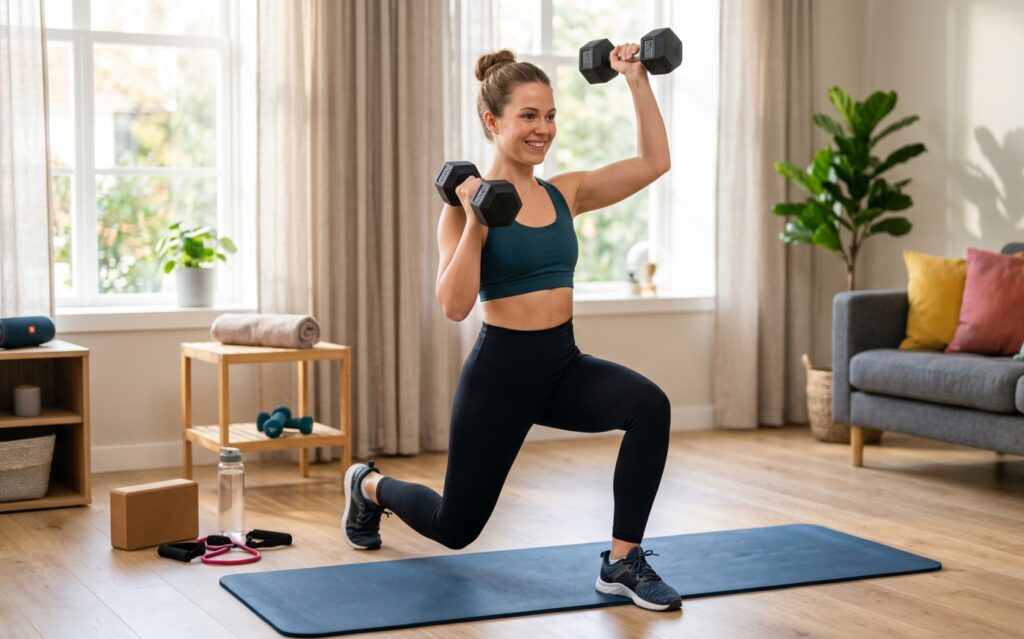
The gym membership I never used sat in my wallet for two years. I’d scroll through workout videos of people in beautiful spaces with expensive equipment, feel a surge of motivation, and then realize I had a six-foot-square patch of floor in my living room, a yoga mat that had seen better days, and no plan. Sound familiar?
Here’s the thing nobody tells you when you’re getting into fitness: your body doesn’t know where you are. It doesn’t care if you’re in a state-of-the-art gym or a cramped apartment with a chair and a wall. It responds to stimulus. Tension, movement, consistency. That’s it. The challenge isn’t the space or the equipment. It’s knowing what to actually do.
So let’s build some routines. Real ones. The kind you can do in your living room, with minimal or no equipment, whether you have twenty minutes or a full hour. No fluff, no complicated choreography, nothing that requires a subscription.
First, a Quick Warm-Up That Actually Matters
Skipping warm-ups is how you get hurt and feel stiff for days. Five minutes is all you need. The goal is to raise your heart rate slightly and move your joints through their full range.
The Five-Minute Wake-Up:
- Arm circles, thirty seconds forward, thirty seconds backward.
- Bodyweight squats, slow and controlled, ten reps just to feel the movement.
- Cat-cow stretches on the floor, flowing between the two positions slowly, about a minute total.
- Walking lunges across your living room and back, ten total steps.
- Jumping jacks or marching in place for a minute to get the blood moving.
Now you’re warm. Let’s get into the actual work.
The Twenty-Minute Bodyweight Circuit (No Equipment, No Excuses)
This is for the days when you’re short on time but still want to feel like you did something real. The format is simple: do each exercise for forty seconds, rest for twenty seconds, move immediately to the next. Complete the entire circuit, rest for one minute, then do it again. Two full rounds.
Exercise One: Bodyweight Squats
Stand with feet shoulder-width apart, chest up, lower yourself like you’re sitting into a chair, then drive back up. Focus on control, not speed. If regular squats feel too easy, pause at the bottom for two seconds.
Exercise Two: Push-Ups
Standard push-ups, but here’s the key: if you can’t do full push-ups yet, do incline push-ups with your hands on a couch or a sturdy chair. You’ll build more strength with good-form inclines than with sloppy full push-ups. Leave the ego at the door.
Exercise Three: Alternating Reverse Lunges
Step one foot backward, lower your back knee toward the floor, push through your front heel to return. Alternate legs. Keep your torso upright. If balance is an issue, hold onto a wall.
Exercise Four: Plank Shoulder Taps
Get into a plank position, hands under shoulders, body in a straight line. Tap your right hand to your left shoulder, then left hand to right shoulder, without letting your hips rock side to side. This is brutal on the core.
Exercise Five: Glute Bridges
Lie on your back, knees bent, feet flat on the floor. Squeeze your glutes and lift your hips until your body forms a straight line from shoulders to knees. Hold at the top for a beat, lower with control.
Two rounds of this circuit, with the rest minute in between, takes about twenty-two minutes. It’s full body, it gets your heart rate up, and it requires exactly zero equipment.
Strength Building When You Only Have a Pair of Dumbbells
If you have a single pair of dumbbells, or even a resistance band, you can add real progressive overload to your home workouts. This routine is structured differently: straight sets with rest between them, focusing on building strength rather than conditioning.
Goblet Squats: 3 sets of 10 to 12 reps
Hold one dumbbell vertically against your chest with both hands. Squat. Keeping the weight close forces your core to stabilize. Rest sixty seconds between sets.
Dumbbell Rows: 3 sets of 10 reps per side
Grab a chair or put one hand on the edge of your couch. Hinge forward with a flat back, dumbbell in the other hand, and row it up toward your hip. Squeeze your back at the top. Switch sides after each set.
Floor Press: 3 sets of 10 to 12 reps
No bench needed. Lie on your back, knees bent, dumbbells in both hands pressed straight up over your chest. Lower your elbows until they touch the floor, then press back up. This hits your chest, shoulders, and triceps without the shoulder strain some people get from push-ups.
Romanian Deadlifts: 3 sets of 10 reps
Hold dumbbells in front of your thighs. Soft bend in the knees. Hinge at your hips, sending them backward, letting the weights track down your shins. Feel the stretch in your hamstrings. Keep your back flat. Return to standing by driving your hips forward.
Overhead Press: 3 sets of 8 to 10 reps
Standing or seated with back support, press the dumbbells from shoulder height to overhead. Keep your core braced. Don’t arch your lower back to cheat the weight up.
This workout takes about thirty-five minutes and leaves you genuinely stronger with consistency.
The Cardio That Doesn’t Feel Like Punishment
Running in place for half an hour is miserable, and nobody sticks with it. You don’t have to do that. Home cardio can be playful and still incredibly effective.
The Ten-Minute Ladder:
Pick four exercises. For example, high knees, burpees, mountain climbers, and jump squats. Start a timer. Do ten reps of each, then nine reps, then eight, all the way down to one. Rest only when you absolutely have to. The total work decreases each round, which tricks your brain into pushing through. By the time you feel like quitting, the hardest part is already over.
Shadow Boxing:
No bag required. Put on music with a strong beat. Stand in a comfortable stance and throw punches. Jabs, crosses, hooks, uppercuts. Move your feet. Duck and weave imaginary punches. Three rounds of three minutes with a minute of rest between them. It’s a genuine cardio and coordination workout that makes you feel like a fighter without getting hit in the face.
Dance Like Nobody’s Judging (Because Nobody Is):
Put on a playlist that makes you want to move. Set a timer for fifteen minutes. Dance. That’s it. No rules, no choreography. Just sustained movement to music you love. You’ll burn calories, elevate your heart rate, and actually enjoy yourself. Consistency beats intensity for long-term results, and you’re far more likely to dance again tomorrow than you are to force yourself through another joyless HIIT session.
The Mobility Finisher You’ll Actually Thank Yourself For
After any workout, spend five minutes on these. Your future self will be grateful.
- Child’s pose: Sit back on your heels, arms stretched forward, forehead on the floor. Breathe deeply for a minute.
- Couch stretch: Kneel facing away from your couch, put one foot up on the seat behind you, and lean forward slightly. Brutal hip flexor stretch. A minute per side.
- Thread the needle: On all fours, slide one arm under your body, rotating your torso until your shoulder and head rest on the floor. Breathe into the stretch across your upper back. Switch sides.
- Downward dog to upward dog flow: Move slowly between the two poses for a minute, syncing breath with movement.
A Few Ground Rules That Keep You Showing Up
The best home workout is the one you actually do. Here are the principles that have kept me more consistent than any burst of motivation ever could.
Schedule it like a meeting. Pick three or four days a week. Put them on your calendar. Non-negotiable. Even if the workout is short, you’re building the habit of showing up.
Have a plan before you start. Don’t wander into your workout space and improvise. Decide the night before what routine you’re doing. Decision fatigue kills workouts before they begin.
Progress, not perfection. Write down what you did. Next time, try to do one more rep, add slightly more weight, or rest a little less. Tiny improvements compound into real change over months.
Respect your recovery. Soreness is normal. Pain is not. If something feels wrong, stop. Rest days aren’t weakness. They’re when your body actually builds the strength you’ve been working for.
The Bottom Line
A home workout doesn’t need to be flashy to be effective. It doesn’t need expensive equipment or a dedicated room or a complicated program designed by someone who trains celebrities. It needs to be consistent, challenging enough to force adaptation, and simple enough that you can do it without thinking.
Your body is the gym. The floor is your platform. A pair of dumbbells is a luxury, not a requirement. Start where you are, with what you have, and let the habit carry you forward. The version of you six months from now will look back and be glad you started today.