The human body doesn’t come with a receipt. When you’re injured in an accident, the pain is real, the limitations are real, the sleepless nights are real, but none of that automatically translates into evidence that an insurance company will accept. Pain is subjective. Insurance claims require documentation. If it wasn’t written down, photographed, or recorded by a medical professional, it didn’t happen as far as the adjuster is concerned.
This isn’t because insurance companies are evil, though they certainly have their moments. It’s because they process thousands of claims, and some percentage of those claims are exaggerated or fraudulent. Their job is to pay what’s owed, not what’s claimed. Your job is to build a record so clear and so consistent that there’s no room for doubt about what you’ve been through.
Here’s how to document injuries properly, from the moment of impact through recovery, in a way that protects your claim and your credibility.
Start Immediately: The Golden Hour of Documentation
The best time to start documenting is right now. Not tomorrow. Not when you feel up to it. The clock starts ticking the moment the accident happens, and evidence that isn’t captured early is evidence that’s lost forever.
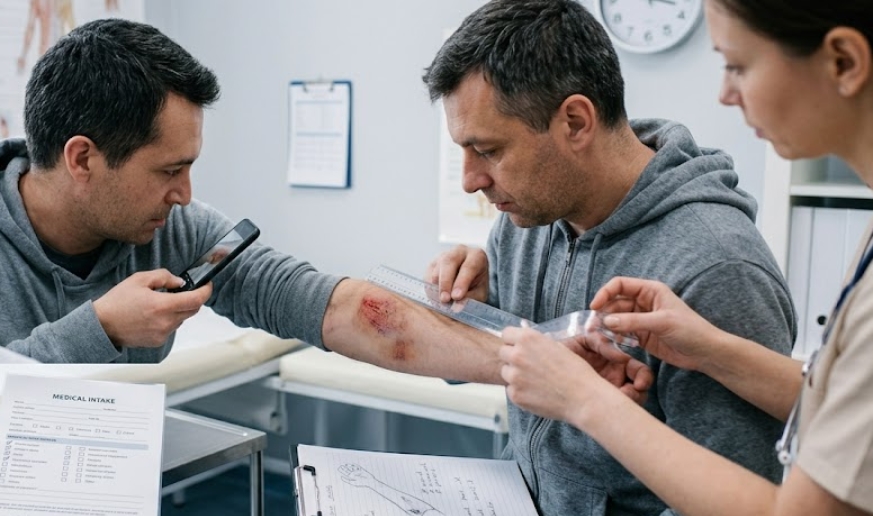
If you’re physically able, the first documentation happens at the scene. Photograph everything visible on your body. That cut on your forehead. The bruise forming on your arm from the airbag. The red mark across your collarbone from the seatbelt. Injuries evolve over time. Bruises darken, then fade. Swelling peaks, then subsides. The initial presentation of an injury matters, and the camera on your phone is your first and most accessible tool.
Take the photos immediately, before you clean up, before the blood is wiped away, before the swelling is hidden by ice packs. These images are uncomfortable to look at, but they’re the baseline. They establish that the injury existed at the scene, which connects it directly to the accident.
If someone else takes photos of you, that’s even better. A photo you take yourself in a mirror is good. A photo taken by a witness, a police officer, or a medical responder carries more weight because it’s independently captured.
Seek Medical Attention Promptly
This cannot be stressed enough. Go to a doctor. Go to an emergency room. Go to an urgent care clinic. Go somewhere where a medical professional will examine you and create a record. And go soon. A gap of days or weeks between the accident and your first medical visit is a gap that the insurance company will use to argue that your injuries weren’t serious, or that they were caused by something else entirely.
When you see the doctor, describe everything. Do not be stoic. Do not minimize your pain. Do not say “I’m fine” when you’re not fine. The medical record that’s created in that visit will follow your claim for months. If you mention only your neck pain and forget to mention the headache that started an hour ago, the insurer will later question why the headache isn’t in the initial record. Be thorough. Be specific. “My lower back hurts, especially on the left side, and it hurts more when I try to bend forward. I also have a dull headache at the base of my skull. My right knee is swollen and I can’t put full weight on it.” That’s the level of detail that builds a credible record.
If the doctor recommends tests, get them. If they recommend follow-up visits, schedule them and attend them. Gaps in treatment are red flags to insurance adjusters. If you stop going to physical therapy because it’s inconvenient, the insurer will argue that you stopped because you were healed. Consistency in treatment demonstrates that the injury is ongoing and that you’re taking your recovery seriously.
The Injury Journal: Your Daily Record of Pain and Limitation
Medical records show what your doctor observed and diagnosed. They don’t show what you’re experiencing day to day. That’s where a personal injury journal comes in, and it’s one of the most powerful pieces of evidence you can create.
Start a simple log. It doesn’t need to be elaborate. A notebook, a notes app on your phone, a document on your computer. Every day, or at least several times a week, make an entry that covers a few key points.
Rate your pain on a scale of one to ten, and be honest. A seven is serious, interfering with daily life. A three is annoying but manageable. Don’t inflate the numbers, and don’t downplay them. Describe where the pain is. Describe what it feels like. Sharp, dull, burning, throbbing, electric. The quality of pain matters.
Describe what you couldn’t do that day because of your injury. This is the most important part. The insurance company doesn’t care about your pain in the abstract. They care about how the injury has affected your life. “Couldn’t pick up my toddler because of back pain.” “Had to cancel a work meeting because I couldn’t sit for more than thirty minutes.” “Couldn’t sleep through the night. Woke up three times because of shoulder pain.” “Unable to cook dinner. Had to ask my partner to do it.” These specifics are devastating in their ordinariness. They paint a picture of a life disrupted.
Describe your mood and mental state. Injuries are emotionally taxing. Anxiety, depression, frustration, and helplessness are common. Documenting these isn’t weakness. It’s evidence of the full impact of the injury. “Felt really down today. It’s been three weeks and I’m still not better.” “Had a panic attack driving past the intersection where the accident happened.” These are real consequences, and they belong in the record.
The journal doesn’t need to be literary. It needs to be consistent and credible. A few sentences a day, over weeks and months, builds a narrative that no single medical record can capture. By the time the adjuster reviews your claim, you’ll have a detailed, contemporaneous account of your recovery that’s difficult to dismiss.
Photograph the Progression, Not Just the Beginning
Injuries change over time. The bruise that was red on day one turns purple on day three, green on day seven, yellow on day ten. The swelling goes down. The scar forms, matures, and fades. Photographing this progression creates a visual timeline that’s hard to dispute.
Take photos in consistent lighting. A bathroom with good, even light works well. Take them from consistent angles. A front view, a side view, and a close-up of the specific injury. If possible, have someone else take them. Include a reference for scale if the injury is small, or if you’re documenting swelling that might not be obvious in a photo alone.
If you’re using a brace, a sling, crutches, or any other medical device, photograph yourself using them. These images show the functional impact of the injury in a way that words sometimes can’t.
Witness Statements: The People Who See Your Struggle
You’re not the only one who knows what you’re going through. Your family sees it. Your coworkers see it. Your friends see it. Their observations can corroborate your account and add credibility to your claim.
Ask your spouse or partner to write a brief statement about how your injury has affected you and your household. “Before the accident, she did all the cooking. Now I have to do it, and she can’t even stand at the counter for more than a few minutes.” “He used to take the kids to the park every Saturday. He hasn’t been able to do that in two months.” These statements from people who have no financial stake in your claim are persuasive precisely because they’re not you.
Coworkers can document changes in your work performance. A brief note from a supervisor or a colleague who noticed you struggling with tasks that used to be routine, or who covered for you when you couldn’t complete something, adds another layer of independent verification.
The Financial Record: What the Injury Is Costing You
Insurance claims ultimately come down to numbers. The pain and suffering are real, but so are the bills. Document every expense related to your injury, no matter how small.
Medical bills, obviously. Prescription costs. Over-the-counter medications. Ice packs, heating pads, braces, and bandages. Mileage to and from medical appointments. Parking fees at the hospital or clinic. Time off work, including the specific dates and the wages lost. If you had to hire help for tasks you could previously do yourself, childcare, house cleaning, lawn maintenance, document those expenses.
Keep every receipt. Log every mile. Record every missed day of work. A spreadsheet is fine. The format matters less than the completeness. When you present a claim that accounts for every cost, you demonstrate that you’re organized, credible, and not making things up.
The Narrative: Connecting the Dots
Individual pieces of evidence are just that, pieces. The adjuster needs to see the whole picture. At some point, either when you submit your demand letter or when you present your case to an attorney, you’ll need to pull everything together into a coherent narrative.
This narrative should connect the accident to your injury, your injury to your treatment, your treatment to your limitations, and your limitations to the impact on your life. It should be factual, not emotional. Let the evidence do the work. Reference the medical records. Quote from your journal. Include the photos. Cite the witness statements. Tally the expenses.
A well-documented claim doesn’t need to shout. It doesn’t need to exaggerate. It simply needs to show, clearly and consistently, what happened, what it cost, and how it changed your life. That kind of claim is difficult for any adjuster to dismiss, because it’s built on a foundation of evidence that would hold up if it ever had to go before a judge or jury.
The Bottom Line
Documenting injuries for an insurance claim is not complicated work, but it is disciplined work. It requires you to pay attention to your own body and your own life at a time when you’d rather look away. It requires you to write things down when you’re tired and in pain. It requires you to keep receipts, take photos, and ask people to vouch for you.
The effort is worth it. The difference between a claim that’s taken seriously and a claim that’s nickel-and-dimed often comes down to the quality of the documentation. Insurance companies deal in evidence. Give them evidence. Give them so much clear, consistent, well-organized evidence that the only reasonable thing to do is pay what you’re owed.
Start today. Open that note on your phone. Take that photo. Write down what hurts and what you couldn’t do. These small acts of documentation are acts of self-protection. They’re how you take control of a situation that has, by its nature, taken control from you. The injury happened to you. The documentation is something you do for yourself. Do it well.