Mars has been pulling at our imagination for a very long time. The ancient Egyptians named it Har decher, the Red One. The Greeks called it Ares after their god of war. The Romans gave it the name we still use today. For most of human history, it was just a reddish dot that moved differently from the other dots, a wandering star with a strange, looping path across the sky.
Then came telescopes, and the canals that weren’t really there. Then came the first grainy images from Mariner 4 in 1965, showing a cratered, moonlike world that dashed dreams of Martian civilizations. Then came the Viking landers, and the first soil samples, and the long, quiet decades when the question of life on Mars became a question of patience and incremental science.
We are now, right now, living through a golden age of Mars exploration. The pace of discovery has accelerated to something that would have seemed like science fiction even twenty years ago. Rovers that drive themselves across the surface. A helicopter that flies in an atmosphere thinner than the top of Mount Everest. Plans to bring pieces of Mars back to Earth. And, more quietly, the steady accumulation of evidence that this cold, dry, irradiated planet was once a very different world.
Here’s where we are, what we’ve learned, and what’s coming next.
The Perseverance Rover: Seeking Signs of Ancient Life
When NASA’s Perseverance rover landed on Mars in February 2021, the dramatic sky-crane descent and the first high-definition video of a landing on another planet made global headlines. But the landing itself was just the beginning of a mission that has been quietly revolutionizing our understanding of the planet’s past.
Perseverance was sent to Jezero Crater, a forty-five-kilometer-wide impact basin that was chosen because orbital imagery showed clear evidence of an ancient river delta. Water once flowed into this crater, carrying sediments and depositing them in layers. On Earth, river deltas are excellent environments for preserving signs of past life. The logic for Mars was the same. If life ever existed on the red planet, Jezero is the kind of place where its chemical fingerprints might still be detectable.
The rover has spent the last few years exploring this ancient landscape, and what it has found is remarkable. The rocks of Jezero tell a story of a long-lived lake, fed by that river, in an environment that was not briefly wet but persistently so. Some of the rocks Perseverance has examined are igneous, formed from molten material, and their chemistry suggests they interacted with water multiple times over a long history. The delta itself contains fine-grained mudstones and sandstones, exactly the kind of rocks that, on Earth, would be prime candidates for preserving organic matter.
Perseverance carries an instrument called SHERLOC, a spectrometer that can map the distribution of organic molecules and minerals at a microscopic scale. It has detected organic compounds, carbon-based molecules, in multiple rock samples. This is not the same as detecting life. Organic molecules can be produced by geological processes as well as biological ones. But finding them in rocks from a habitable ancient environment means the building blocks of life, as we understand it, were present. The question of whether those building blocks ever assembled into something living remains open, and the answer may come from the samples Perseverance is collecting.
The Sample Return: Bringing Mars to Earth
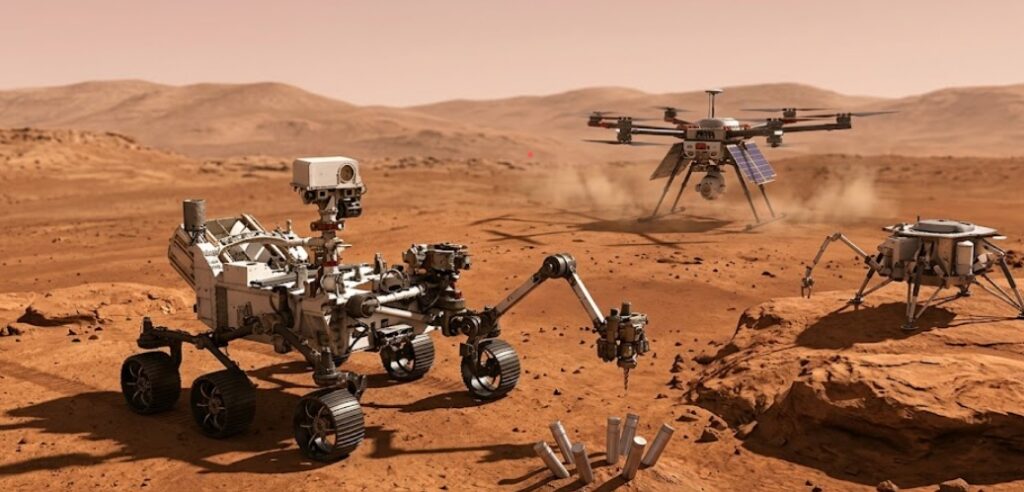
The most ambitious part of Perseverance’s mission is underway right now and will take years to complete. The rover is collecting samples of Martian rock and soil, sealing them in sterile titanium tubes, and caching them on the surface for a future mission to retrieve and return to Earth.
This is not a simple operation. The plan, developed jointly by NASA and the European Space Agency, involves multiple spacecraft and a series of steps that have never been attempted. A Sample Retrieval Lander will touch down near the cached tubes. A small fetch rover, or possibly Perseverance itself if it’s still operational, will collect the tubes and bring them back to the lander. The tubes will be loaded into a small rocket called the Mars Ascent Vehicle, which will launch from the surface of Mars, the first rocket ever to do so, carrying the samples into orbit. There, a European-built orbiter will capture the sample container and carry it back to Earth, where it will descend under parachute to a desert landing site.
The scientific payoff is difficult to overstate. Earth-based laboratories can analyze samples at a level of detail that no rover instrument can match. We’ll be able to determine the absolute ages of Martian rocks, which will calibrate the entire planetary timeline. We’ll be able to search for fossilized microbial cells at resolutions down to the nanometer scale. We’ll be able to measure isotopic ratios that reveal past temperatures and environmental conditions. The samples Perseverance is collecting right now will be studied for decades by scientists who haven’t even been born yet.
The timeline for the return, originally targeted for the early 2030s, is in flux. The complexity and cost of the mission have led to reviews and potential redesigns, and the schedule will undoubtedly shift. But the samples are being collected. They’re sitting on the surface of Mars, waiting.
Ingenuity: The Little Helicopter That Could
NASA expected the Ingenuity helicopter to fly five times. It was a technology demonstration, a thirty-day experiment to see if controlled, powered flight was even possible in the Martian atmosphere, which has less than one percent the density of Earth’s. The helicopter was small, weighing under two kilograms, with rotor blades that spun at twenty-four hundred revolutions per minute, far faster than any Earth helicopter. No one knew if it would work.
Ingenuity flew seventy-two times over nearly three years, far outlasting its planned operational life. It scouted ahead of Perseverance, surveying terrain and identifying routes. It flew a total distance of over seventeen kilometers. It survived dust storms and cold nights. It became, in its own strange way, a beloved figure in the story of Mars exploration, a tiny, fragile machine doing something entirely new on another world.
The helicopter’s final flight, in January 2024, ended with a damaged rotor blade after a rough landing in featureless terrain that confused its navigation system. But its legacy is secure. Ingenuity proved that aerial exploration of Mars is viable, and it has opened the door for future, more capable rotorcraft. Plans are already underway for larger drones that could carry scientific instruments, explore terrain that rovers cannot reach, and serve as scouts for future human missions.
The Fleet: It’s Not Just NASA
For decades, Mars exploration was dominated by NASA, with occasional efforts from other space agencies that often met with mixed success. That landscape has changed.
China’s Tianwen-1 mission, which arrived in 2021, successfully deployed an orbiter, a lander, and the Zhurong rover, making China the second nation after the United States to operate a rover on the Martian surface. Zhurong explored the Utopia Planitia region, studying local geology and searching for subsurface water ice. The orbiter continues to collect data, and China has announced plans for a sample return mission of its own, potentially launching before the NASA-ESA effort.
The United Arab Emirates’ Hope orbiter, which arrived in 2021, took a different approach. Rather than studying the surface in detail, Hope observes the Martian atmosphere on a global scale, tracking weather patterns, dust storms, and the escape of atmospheric gases into space. The mission was designed with strong international collaboration and a focus on building scientific capacity in the UAE. It has produced stunning images of the Martian atmosphere and new insights into the planet’s climate dynamics.
Even India’s Mars Orbiter Mission, which ended in 2022 after eight successful years, demonstrated that a capable Mars mission could be executed on a relatively modest budget. The spacecraft studied Martian surface features and atmospheric composition, and its success has fueled ambitions for a follow-on mission.
The democratization of Mars exploration is a significant development. More nations with more spacecraft means more data, more perspectives, and a distributed scientific community that’s less dependent on any single space agency.
Water: The Story Keeps Getting More Interesting
The question of water on Mars has shifted, over the decades, from “was there ever water?” to “how much water, for how long, and where is it now?” The answers keep getting more interesting.
We know that ancient Mars had liquid water on its surface. The evidence is everywhere: river valleys, lake beds, delta formations, minerals that only form in the presence of water. Gale Crater, explored by the Curiosity rover, was once a lake. Jezero Crater, explored by Perseverance, was once a lake fed by a river. The southern highlands are scarred by channels that could only have been carved by flowing water. Mars was not briefly wet. It was wet for geologically significant periods, and the conditions may have been clement enough for life to emerge.
Where that water went is partly understood. Some was lost to space, stripped away by the solar wind after Mars lost its global magnetic field and its atmosphere thinned. Some is frozen in the polar ice caps, which contain layers of water ice and carbon dioxide ice that record past climate cycles. Some is locked in subsurface ice deposits that have been detected by orbiting radar instruments.
The European Space Agency’s Mars Express orbiter, still operating after two decades, has been mapping subsurface water with its MARSIS radar instrument. It detected what appears to be a lake of liquid water beneath the southern polar ice cap. The finding is controversial and requires more study, but if confirmed, it would be the first stable body of liquid water known on present-day Mars, a potential habitat for microbial life and a resource for future human explorers.
More recently, data from multiple missions have revealed that liquid water may not be confined to the polar subsurface. Evidence of wet slope streaks, called recurring slope lineae, has been debated for years. While they may be dry flows of sand and dust rather than water, the broader picture of subsurface water ice across the mid-latitudes is now well established. There is water on Mars. A lot of it. It’s just frozen or buried or both.
The Atmosphere: Thin, Dynamic, and Leaking
Mars’ atmosphere today is a ghost. Surface pressure is roughly one percent of Earth’s, and the composition is mostly carbon dioxide. It’s too thin to support liquid water on the surface for long. Yet it’s not a static, dead atmosphere. It’s dynamic and active in ways that have implications for everything from landing spacecraft to planning human missions.
The MAVEN orbiter, which arrived in 2014, has been studying how the Martian atmosphere interacts with the solar wind and how atmospheric escape stripped away the thicker, wetter atmosphere of the ancient past. Its data suggest that atmospheric loss was not a slow, steady process but occurred in bursts, driven by solar storms and other events.
Dust storms are the most dramatic atmospheric phenomenon on present-day Mars. They can grow from local disturbances to planet-encircling events that shroud the entire planet in a haze of fine red dust. The 2018 global dust storm ended the Opportunity rover’s mission by blocking sunlight from its solar panels. These storms change the temperature structure of the atmosphere, loft dust to high altitudes, and modify the planet’s climate on seasonal and interannual timescales. Understanding them is critical for designing future missions, particularly solar-powered ones and any mission that involves landing through a dust-charged atmosphere.
The UAE’s Hope orbiter has added a new dimension to atmospheric science by providing global, synoptic views of the atmosphere at different times of day. Its observations of discrete auroras, localized patches of atmospheric glow caused by interactions between the solar wind and Mars’ remnant crustal magnetic fields, revealed a phenomenon that hadn’t been fully characterized before.
The Human Horizon
All of this robotic exploration, the rovers, the orbiters, the sample return planning, is ultimately in service of larger questions. How did Mars evolve from a potentially habitable world to the cold desert it is today? Was there ever life there? And, the question that drives the human program forward: could humans live and work on Mars?
The challenges of a human mission are staggering. The radiation environment on the journey and on the surface is hazardous, with no magnetic field and a thin atmosphere providing little protection. The transit time, six to nine months each way, creates logistical demands for food, water, air, and psychological support. The surface operations would require living off the land to some degree, extracting water from subsurface ice and potentially producing oxygen from the carbon dioxide atmosphere, a technology demonstrated on a small scale by the MOXIE instrument on Perseverance.
NASA’s Artemis program, focused on returning humans to the Moon, is framed as a stepping stone to Mars. The technologies for long-duration surface habitation, in-situ resource utilization, and deep-space operations will be tested on the Moon first. The timeline for a human Mars mission is fluid, dependent on funding, political will, and the resolution of technical challenges that are not yet solved. NASA’s official target is the 2030s or 2040s. SpaceX’s Starship program, with its rapid iteration and ambitious goals, has publicly targeted an earlier window.
When humans do reach Mars, they will arrive at a planet that has been extensively mapped, analyzed, and understood by the robotic precursors that came before them. They’ll know where to find water. They’ll understand the weather. They’ll have high-resolution maps of landing sites. The robots have been the advance scouts, and they’ve done their work well.
The Bottom Line
Mars exploration right now is a convergence of multiple tracks: the search for past life via Perseverance and sample return, the study of the planet’s history and climate via a fleet of international orbiters and landers, the development of technologies like aerial vehicles and in-situ resource utilization, and the slow, steady buildup toward human exploration.
Each discovery opens new questions. The organic molecules found by Perseverance. The subsurface lakes hinted at by radar. The history of water revealed by the rocks of ancient lakebeds. These findings don’t close the book on Mars. They write new chapters.
The red planet is no longer the mysterious, unreachable world it was even a generation ago. We drive rovers across its surface. We fly helicopters in its thin air. We are planning, with sober engineering assessments, to bring pieces of it home. The distance between Earth and Mars hasn’t changed. But the distance between humanity and Mars has shrunk dramatically, powered by decades of accumulated science, technology, and the stubborn human conviction that the red dot in the sky is a destination, not just a light.